One man's view of theology, sports, politics, and whatever else in life that happens to interest me. A little bit about me.

Saturday, April 14, 2018

Does God Care about Sports?

I want to start off by saying this is the kind of theological article I don’t like to write. I like to write things that have an unassailable proof from Scripture backing it up. That being said, I also like to write about  things that interest me, and this is certainly one of them. Feel free to comment if you disagree or want to discuss further.

I am a sports fan. I don’t watch or follow sports as much as I used to, but I still consider myself a fan. I grew up in southeast Missouri, where it seems the sun rises and sets on the St. Louis Cardinals. Some of my most treasured memories from my childhood involve sitting around the table with Grandpa or riding in the car with Dad listening to Jack Buck announcing the Cardinals games. Most of the time when I was a kid the Cardinals weren’t very good, but that didn’t seem to matter. It was more about sharing common bonds with family and people around you and spending time with a trusted friend. I can’t tell you how many times Jack Buck helped me with my homework, even in college, by saying just the right thing at the right time.

As a believer though, I (and all of us) have to ask myself if God cares about sports. Unfortunately in my experience this question usually arises from a well-meaning brother or sister in Christ who doesn’t like sports trying to criticize or demean those of us believers who do like sports. Most Christians I know have the idea that God does not care at all about sports. What happens in a particular game or season does not matter to God in any way. I think this thinking arose to keep people from praying for God to help their team win.

I think praying for your team to win is pretty much an exact definition of asking amiss that James warned us about in his epistIe. But I also think the idea that God never interferes in sports events is a flawed idea as well. I acknowledge that in the grand scheme of things as far as God is concerned, who wins or loses in a sporting event is very low on God’s priority list. But I want to propose to you that God can and does take an interest in sports when He can use them to build his Kingdom or bring joy to his people. I want to demonstrate this with a true story that happened 20 years ago today.

Tuesday, April 14, 1998, I was winding down my first year away at college. (I went to community college two years before.) It was a rough year for me. It was my first time being so far from home. By April I had been gone long enough that I had gotten over the raw emotions of being gone, but the feelings still nagged. April 14 happened to be a particularly rough day. I honestly don’t remember any particularly bad details - you’ll understand why in a moment - I just remember it as a bad day. I was really in a bad state of mind.

That night, I had the radio on, listening to the Cardinals game (so grateful for the massive signal of KMOX). Of course 1998 was the year that Mark McGwire and Sammy Sosa broke the record for the most home runs in a season, but that was a long way into the future in April. I wasn’t paying very close attention to the game, but I did notice Mark McGwire hit a home run early in the game. Then later he hit another home run to give the Cardinals the lead, which made me happy.
By the eighth inning the game was a blowout, and the Cardinals certainly weren’t going to bat in the bottom of the ninth. So in the bottom of the eighth, McGwire came to bat one last time. I was listening pretty intently just to see if something would happen. Sure enough, a third homer for that night.

As I was quietly celebrating - I did have roommates after all, but they were used to me listening to baseball - celebrating the three home runs I heard a voice, clear as day, in my heart tell me, “That was for you.” To this day I believe that voice was from God. And why not? Looking at the box score for that game, the Cardinals were already up by 6 runs in the eighth when that third home run was hit. Would it really matter to God if the final score was 11-5 or 15-5? No. But do I matter to God? I am humbled and thankful that the answer is yes. And if the Lord knew he could raise my spirits by having that little ball go over the fence, why not give it a little extra breeze on the way out?


We evangelicals agree that God is in control of everything, don’t we? We agree that God works in big and small ways for our good and for the good of the church. Then why do some people think that the sports arena is so sacrosanct that God never gets involved? I think the people who think that God does not care are the ones who place sports on a higher pedestal than they should be. God can work in a myriad of other ways, but what happens on the sports field is always pure athleticism? Come on. Why do you limit God?

All I’m saying is this: when you’re watching your team lose a big game, it’s OK to be disappointed. But it might make you a little happier to know that in the opposing city there may be a dear old saint watching in a hospital bed surrounded by his family, and God is giving the family one last precious memory before he goes home to be with Jesus. Or maybe there is a genuine seeker in the stands who wants to know God is real. Or maybe it’s a thousand other scenarios.Those scenarios won’t get talked about the next morning on ESPN or in next week’s hometown newspaper, but I believe they are more real than the strategy points that people discuss.

God is at work in the big things and the tiny things in life all the time. He is bringing his Kingdom to fruition in more ways than we can imagine. God's sovereign power over the affairs of this world means he controls everything, including, as Jesus said, when a sparrow falls out of a tree. If God can bring something good into the lives of his people and even people who don't yet know him, through a sporting event, whether it is the Super Bowl or the local peewee football league, why wouldn't he? When we pretend these things don’t matter to God, all we really do is limit him in our own minds.

Tuesday, August 15, 2017

The Crook, the Clown Show and Mo Brooks

Today is the primary election day in Alabama for the race to fill the unexpired term of US Senator Jeff Sessions, who was appointed Attorney General by President Trump. The three main candidates in the Republican primary are Luther Strange, who was appointed by former Governor Bentley to temporarily fill the seat, Roy Moore, best known as the judge who tried to put a 10 Commandments monument in the state Supreme Court building, and Mo Brooks, a congressman from Huntsville.


Personally I'm not a fan of any of the three candidates. Ordinarily I would research the lesser known candidates on the ballot and vote for one of them. But the Alabama election rules mean there will in all likelihood be a runoff in a few weeks between the two top vote winners. That's why I am reluctantly casting my vote for Brooks. When it comes down to a choice between a run-of-the-mill politician, a crook and a clown show, the politician wins.


The Crook


Before his appointment, Luther Strange was the Alabama Attorney General. When Trump won the election in November, everyone knew that Jeff Sessions would be part of Trump’s Cabinet, which meant there would be an opening in the US Senate seat. At the same time, the Alabama Legislature was contemplating impeachment of Governor Bentley .


In November (but before the presidential election) Strange announced his office was investigating Bentley. The Legislature agreed to postpone action until Strange's investigation was complete. Before the investigation was complete, Bentley appointed Strange to Sessions' seat. Strange insists there was no quid pro quo, but it shouldn't take a law degree to see the obvious conflict of interest. At the press conference announcing his appointment, Strange denied that his office was investigating the governor, but his successor as Attorney General confirmed there was and recused himself because he was appointed by the governor. After this fiasco, the Legislature went ahead with its own impeachment proceedings. Bentley agreed to a plea bargain and resignation a few weeks later.


The Clown Show


Roy Moore is more principled person than Strange, I will grant him that. But his penchant for needlessly creating controversy disqualifies him as a candidate, in my mind. In 2001, while he was Alabama Chief Justice (an elected position in Alabama), Moore made national headlines by loudly and publicly erecting a 10 Commandments monument in the lobby of the Alabama Supreme Court building. The pompous way Moore did it (including selling videotapes featuring the installation and his speech) invited controversy. Atheist organizations sued and successfully persuaded a federal court that it should be removed. After Moore lost all appeals he still refused to remove it, resulting in his removal by the Alabama Court of the Judiciary in 2003.


After a few years in obscurity (which included losing a race for governor and flirting with a third-party run for president) Moore ran again for Chief Justice in 2012 and won again. Once again he couldn’t stay out of the headlines. After the US Supreme Court legalized homosexual marriage, Moore instructed county officials not to issue or honor them in Alabama. After numerous court proceedings, Moore was forced to resign earlier this year, just in time to run for Senate. The Senate would be a perfect platform for Moore’s brand of political opportunism: he could make speeches and vote however he wants without having to do any of those annoying things like obey the law as an officer of the court.


If doing public good was the only criterion for Senate, then I would probably vote for the leading Democratic candidate Doug Jones, a long-time prosecutor best known for successfully prosecuting numerous people who committed criminal acts during the Civil Rights Movement in the 60s and were never charged or had charges dropped. But I cannot vote for a candidate who proudly says on his Web site, “I stand with Planned Parenthood.”

So Mo Brooks it is. If Brooks makes the runoff against either Strange or Moore, I will vote for him again. If Strange and Moore make the runoff, I will not vote. If Strange or Moore win the GOP nomination, I will vote for the Libertarian candidate or push through an empty ballot. I am definitely a “never Strange” and a “never Moore” Alabama voter.

Tuesday, April 4, 2017

Can't We Be Anti-Porn AND Anti-Censorship?

Next time a politician tells you stuff
he thinks you want to hear, think
about Homer Stokes from
"O Brother Where Art Thou?"
(If I knew who to credit with this
awesome illustration I would gladly
do so.)
This week the Alabama State Legislature will hold public hearings on HB 428, a law which proposes to install a porn filter on every Internet-capable device sold in the state starting next year. The law allows for the filter to be removed if the buyer pays $20 to the state (the business is allowed to add a "reasonable" fee). Apparently there are similar laws being proposed in at least two other states.

Let me be perfectly clear: I am against pornography. It is a shame that it is so commonplace on the Internet. The law specifically mentions child pornography and revenge porn. I think all sensible people agree that those are specifically heinous. I am not against people voluntarily installing filter programs on their computers or their children's. In a lot of cases that's probably a wise idea.

But this law is so fraught with problems, loopholes and unexplained realities that if it passes (which it shouldn't, but the Alabama Legislature isn't exactly known for wisdom) it will create more problems than it solves and do way more harm than good.

First of all, the bill requires manufacturers to install the filter. This is really untenable. It is unreasonable to expect even big sellers like Apple, Dell, Samsung, etc., to design specific devices for Alabama, to say nothing of the smaller companies that produce cheaper phones and tablets. They would effectively be put out of business in this state, which would adversely affect the poorest residents who rely on the cheaper devices to access the Internet.

Secondly, the bill says nothing about online sales. There is nothing in the bill that says Amazon and other online retailers have to comply with this law. This is sure to hurt Alabama businesses, as will residents driving to Chattanooga, Pensacola
or somewhere else to buy their devices. There aren't that many places in Alabama that aren't within an hour and a half from some state line.

The law also doesn't address jailbreaking or rooting the device to get rid of the filter without paying the fee. The people who are the real targets of this bill are tech-savvy enough to get around this quite easily. Meanwhile very few will actually pay to get the filter off their device, because who wants to publicly hand their phone across the counter to someone and ask for the filter to be taken off? The public shame will be enough to keep most people away.

More importantly, the simple fact of the matter is that no filter program really works like it is promised to. Filtering software tends to overreach and harm honest users while the real bad guys quickly figure out ways around it. Filters are notorious for keeping helpful information away from people who are in sexually abusive or exploitative situations. If someone can't find a description of what they are experiencing because it is blocked by a filter, how will they know to get out? Believe me, it happens. Abusers have been known to keep filters on their victims' computers.

One thing that is provided for in the law is a means by which people can report offensive material that escapes the filter. Manufacturers are required to update the filter from time to time to meet the concerns raised by citizens. I don't know about you, but I for sure don't want this guy in charge of what I and my family can and cannot look at on the Internet.

Finally, we don't live in a perfect world. People need to be informed about what is going on in the world around them. And sometimes the things they do might not pass muster with an Internet filter. Take, for example, Governor Bentley's affair with a state employee. Several TV and radio stations in the state refused to play the tapes of the lurid conversations for fear of an FCC citation. I have heard a brief snippet of the tapes. 30 seconds was about all I could stomach. How many people are unaware of Bentley's wrongdoing because of those stations' decisions? Maybe that is the reason there isn't more public pressure to impeach him?

One would think the filter would at least be similar to the FCC standard, so ironically the details of the governor's lurid relationship would be off-limits to Alabama residents if this law were to pass. Maybe this is the whole point of the law: the primary sponsor of the bill is a Republican. But honestly, I don't give him or most of the Alabama GOP credit for enough smarts to come up with such a plan to keep the governor's indiscretions under wraps. I think it's simpler to say this law is just grandstanding to please religious conservatives. The GOP thinks they will not consider the real-world ramifications. Instead they will see the GOP standing up against porn and will shower them with support in next year's election. Sadly, they think that because of years of experience in seeing it work.

If you want to see grandstanding in action (or if you have no idea what the above picture is about, watch this clip from "O Brother Where Art Thou":


The fact of the matter is there are already laws against child porn, revenge porn, solicitation and all the other big problems this bill claims to address. Instead of creating a new law that has the potential to harm local businesses, harm the poor and do little to address the real issues, state and local law enforcement should do more to enforce those laws, and the legislature can adjust those laws as may prove necessary. I know that's easier said than done, but passing this particular bill
will help no one, at least no one in Alabama.

Thursday, March 30, 2017

LG V20 Review: Two Great Screens and One Lousy Speaker

About three weeks ago my phone that I'd had for a year and a half bit the dust. I was expecting to get a few more weeks' use out of it before I bought something different with my own money and got out from under the purchase plan with T-Mobile. Unfortunately it went into full bootloop, so I had to get a new one right away from the phone store. There weren't a whole lot of choices for a guy like me who doesn't want Apple or Samsung, so I went with the LG V20.

My LG V20. Note particularly the "second screen" at the top with various function controls.

First Impressions


This phone is advertised as a bigger diagonal screen size than both the Apple iPhone Plus line and the Samsung Galaxy Edge. But thanks to its very small top and bottom bezels it doesn't feel that big in the hand or the pocket. The back of the phone is just a solid sheet of slippery plastic. I nearly dropped it a couple of times in the week before I got a case. The back needs texture or a curve or something.
The back is dangerously
slippery. Also note
the dual rear cameras.

When I first powered up the phone, I was disappointed to see no app drawer. Thankfully with a quick Google search I was able to find out how to change the settings to bring it back where it belongs. This setting should be the default.

Typical for a carrier-store Android phone, there is some bloatware to deal with. Thankfully T-Mobile is not as heavy-handed with the useless apps as is Verizon, and it is worth noting some can actually be uninstalled rather than disabled, including manufacturer apps like LG Health and carrier apps like T-Mobile TV. Thanks, T-Mo and LG!

The swappable battery is not as important a selling point as it used to be. Few phones have them anymore, and if rumors are true this may be one of the last top-of-the-line Android phones to have one. It is handy to be able to swap out a dead battery for a fresh one, but that requires a lot of planning ahead, unless you spring for the additional charging station. The most important advantage to having a swappable battery is it provides a surefire way to reboot the phone if you ever run into serious trouble. I was able to rescue my data off my old phone because the swappable battery enabled me to forcibly turn off the phone.

Second Screen

When the phone is off, the second screen shows the time and
your notifications without having to fire up the whole phone.

The big selling point of this phone is the "second screen," a strip at the top of the phone separate from the rest of the screen. This screen is most useful when the phone is not in use. All you have to do is pick up the phone and the second screen shows the time and any notifications. How many times a day do we smartphone users fire up the whole phone just to check the time or to see if we missed a call or text? With the second screen,  this step is unnecessary. It saves lots of wear on the battery. A swipe on the second screen will reveal a small control panel, enabling you to turn on/off wifi, Bluetooth and the flashlight as well as turning off the sound. A third swipe gives you access to your media controls, meaning you can quickly skip that song you used to like before Pandora started playing it over and over again. This is all done without turning on the whole phone and without signing in. Every phone should have something similar.

When the phone is actually in use, the second screen is less useful, other than the quick access to the controls. It also provides recent apps, but this is just as easily reached from the square button at the bottom of the screen, so it's redundant at best. One interesting feature is that if you get a call while you are doing something in an app, the option to accept or decline the call appears in the second screen, enabling you to decline the call if you wish without switching apps.

Hardware


The sound is disappointing: one single speaker at the bottom. I found a hack that will allow you to set up stereo sound through the earpiece speaker, but I'm not so adventurous as to download software from murky sources onto my phone. With the earphone jack, I ran into an issue with the phone turning down the earphone volume by itself. Maybe that was because of the old jack on the adapter I use on the tape deck in my car. My next project is to install a new car radio with Bluetooth, but for now it's a concern.

I don't really use my phone camera all that much. If I know I'm going to need to take good pictures, I'm bringing along my digital SLR. This phone's camera is fine for what I need. The dual camera setup is pretty cool, actually. I like the dual setup on the selfie camera even better though. It's great for taking group pictures without having to obviously stretch your arm and mess up the picture.

The battery consistently provides a full day's use for me. That might be a little unfair because I can't use my phone at work, so that cuts 8 hours out of the day, but I do use it quite heavily when I'm not on the job. But even on weekends I haven't had to charge it before the end of the day yet. I have frequently got the phone to go a day and a half on a full charge during the week.

Software


The V20 ships with Android 7.0 Nougat. The most important new capability of Nougat is the ability to have two apps open and active at the same time. I haven't actually used it very much because I'm used to multi-tasking using the navigation buttons at the bottom of the screen. The feature did come in handy once when I needed to dial a number I had taken a picture of. No back-and-forth or writing the number down necessary - just open the picture on the top half of the screen and dial the number with the dialer open on the bottom half.

LG has certainly dialed back the customization of its user interface. I remember reading recently that Google was cracking down on the wildly different UIs on various companies' phones with Nougat. It certainly seems to be true with this one, and that's a good thing. LG still has the Apple-esque red notification dots on certain app icons, but that's really the only thing I noticed that differentiated the UI from stock Android - well, once you fix the app drawer.

The 64 GB of storage is plenty for my needs. But if that's not enough, memory is easily expandable with the SD card slot, which reportedly can handle up to 2 TB(!!). I've never seen an SD card bigger than 256 GB, but I guess bigger ones are out there. Like the swappable battery, an SD card may not be necessary with this much standard storage, but I'm not going to complain that it's available.

Conclusion


The chintzy speaker is the one thing keeping me from giving the V20 a fully positive review. Three weeks may be a little early to tell, but so far this seems to be the best phone I've ever used. Definitely a keeper. So far I love the second screen. LG deserves credit for developing a unique idea for a smartphone that's actually useful and enhances the overall experience.

All of us use our smartphones in different ways. If the single speaker is a problem for you, you might want to pass on this one. It also might be troublesome if you really don't want a big phone. But if neither of those are an issue, I would definitely recommend you consider the LG V20. It is blazing fast, has a great camera, expandable storage galore, and is unique enough thanks to its second screen to stand out in a world of slabs that all look about the same.

Tuesday, March 21, 2017

Beauty and the Beast, Sports Illustrated and Lessons Learned

"For the sons of this world are more shrewd in their generation than the sons of light." ~ Jesus, Luke 16:8


I think it's safe to say Disney's marketing strategy promoting Beauty and the Beast was a runaway success. The movie opened with the biggest opening weekend ever for a PG-rated movie and the biggest opening weekend for any movie in March.

A big part of the that strategy was the quote a couple of weeks ago from the director about there being a “gay moment” in the movie. The article was perfectly timed so that the resulting furor would have maximum impact in social media in the week and a half prior to its release date. And a furor they got. It was impossible not to miss the impact of the quote in the week following the article's publishing.

I don't have any doubt that it was intentional. The media have learned their lesson well: get the Christians sufficiently riled up, and you're in for a bonanza. It's too bad many Christians haven't yet learned the same lesson.

One of the most striking examples of this phenomenon is the story of the Sports Illustrated swimsuit issue. The issue is by this time an American institution for better and for worse, mostly worse. For those of us under the age of 60, it's just always been there. But its origins lie at a place where happenstance and Christian outrage met.


Sports Illustrated was not always the behemoth I remember when I was growing up. (Print magazines are so 20th century). In 1964 SI was struggling to find a focus and an audience. It was far behind the largest sports weekly of the day, The Sporting News. And it had difficulty in determining exactly what it wanted to be all the time.

When there wasn't any baseball or football to cover, the magazine looked more like an outdoors or a lifestyle magazine. There were cover stories on hunting, travel, outdoors activities, even yachting with John and Jackie Kennedy.


It was anticipated to be a slow news week in mid-January 1964 (the NFL playoffs were usually over by Christmas back then). The managing editor, Andre Laguerre, planned a Caribbean travel story and told the photographer to hire a model to pose in a bikini for the cover. It was a brazen choice at the time, but Laguerre liked to push the boundaries and had little taste for American moralism. 

The cover (see it at this link if you wish) featured the picture with the following caption: "A Skin Diver's Guide to the Caribbean - Fun in the Sun on Cozumel." There was nothing about "annual swimsuit issue" or anything like that. Inside was a travel story with one more picture of the model and some other pictures of beach scenery.

Three SI covers from the 50s
and 60s that have nothing
to do with sports.
The cover created controversy. The magazine received thousands of angry letters and cancellations. At the same time, newsstand sales of the issue exceeded all expectations for a slow news week. Whether those sales were directly related to the anger expressed I have know way of knowing, but that is what happened.

Any time there is reaction, that is gold to marketers. They really don't care if it is positive or negative, as long as there is a reaction. A single issue which generated this kind of controversy and sales made everyone take notice. In the weeks that followed it was Laguerre who came up with the idea to put another girl in a bathing suit on the cover next year and bill it as the "second annual swimsuit issue."

Thus was born one of the most influential publications in American history. By all rights it should have been another one of those early SI issues that seem so weird to us who remember the magazine's heyday in the 70s-90s. But it lives on because of a firestorm of negative reaction from well-meaning folks.

I'm not saying those folks were wrong about the particular issue. I'm sure it was a shock to many subscribers looking for stories about basketball, hockey or perhaps the upcoming Winter Olympics. But if enough of them had simply and quietly pitched the magazine into the trash can and went on with their lives, the Swimsuit Issue wouldn't be around today. 

More than 50 years later, many Christians still haven't learned this lesson while the world has. The world eagerly lays out plans, knowing many Christians will quickly share anything that irritates them on social media without ever considering if they are being manipulated by either powerful media moguls looking for free publicity or by struggling Web publishers looking for cheap clicks. Either way, the manipulation is real and, unfortunately, easy to pull off. If Christians would just once not take the manipulation bait, the people pulling the strings might think twice about it. Personally I think it'd be nice to see Christians be the manipulators for once instead of the manipulatees. 

Note: The information for this article came mostly from an interview I saw a few years ago on TV with Frank DeFord, longtime writer and editor at Sports Illustrated. Unfortunately I could not find a link with the interview, but the basics of what I remember from the interview are confirmed in this article.

Thursday, February 16, 2017

Jesus vs. Paul?

Misunderstood Verses #2

Matthew 6:14-15: For if you forgive men their trespasses, your heavenly Father will also forgive you. But if you do not forgive men their trespasses, neither will your Father forgive your trespasses. ~ Jesus

Ephesians 4:32: And be kind to one another, tenderhearted, forgiving one another, even as God in Christ forgave you. ~ Paul

Recently I've become aware of a teaching that proposes that Jesus and Paul are at odds in these two statements. They say that Jesus says our forgiveness (which has to mean our salvation, since no one I'm aware of teaches one can be partially forgiven and go to heaven) is based on our forgiveness of others - that is our performance. Paul tells us that we forgive others because of how completely God has forgiven us.

The resolution they provide seems simple enough: Jesus was talking about a different era in God's redemptive history. Before the cross, before the resurrection, before Pentecost, whenever, God dealt with people on the basis of their performance. But now God deals with us based on Christ's all-sufficient work on the cross. It sounds plausible, because Hebrews tells us about the new and living way we have in Christ. But some (not all) who teach this are overzealous for the new and living way. In their exuberance they overlook a God who has always shown mankind mercy and grace.

If Jesus was saying that there was a time (obviously it had to include the time that Jesus was speaking) that God's forgiveness was conditional on our action, then that must mean no one from that era will be in heaven. I don't think I need to post any references to the fact that man can in no way earn God's favor, since if you've read this far you are interested enough in Scripture to understand that. God's grace has never been in this time or any other time based on man's performance.

To de-emphasize God's grace in previous times is to do injustice to our unchanging God and the great heroes of the Old Testament. Genesis 15:6 tells us, "He (Abraham) believed in the Lord, and He accounted it to him for righteousness." Three times in the New Testament (here, here and here) this verse is quoted as an illustration of the way we all must come to God. I'm thankful for the more complete revelation we have in Christ, but all God ever required, requires now and will ever require is belief in him.

So if Jesus was not saying that forgiveness is based on our performance, what did he mean? And how are Jesus' and Paul's statements rectified? To me it seems simple, because the key is in another verse in Ephesians: "For we are His workmanship, created in Christ Jesus for good works, which God prepared beforehand that we should walk in them." (2:10) If we as believers are ordained by God to walk in good works, is it not reasonable to assume that forgiveness will be one of those good works? And if so, then truly one who can never find it in their heart to forgive their fellow human knows nothing of the love, mercy and forgiveness of God.

We as believers will fail to forgive one another completely. If we wouldn't, why would Paul need to encourage us to forgive in the second verse above? We certainly deal with the works of the flesh in our hearts and lives. But we are just as certainly on the road to being the people God wants us to be. God promises to work in our lives to bring us farther on that road, but the journey won't be complete till we get to heaven.

Thursday, November 10, 2016

How Hillary Could Have Won

It's been a couple of days since Election Day 2016. Personally I am not disappointed Hillary lost, but I think she lost for one particular reason: she failed to make the campaign about issues. Had Hillary focused her speeches, her debates and advertising war chest on the contrasts (or, more importantly, the lack thereof) between herself and Trump, she would have driven a wedge between Donald Trump and his conservative base and won easily. Instead she relentlessly attacked Trump's personality, which only fueled his base to get out and vote.

If you had your TV on at any time in the last three months, chances are you saw it: the ad with the children sitting in front of the TV watching as Donald Trump made one extreme remark after another. It probably won't go down in history alongside other memorable TV ads from past campaigns (mostly because Hillary lost and most people remember winners' ads), but it is definitely the most memorable of this campaign. This ad, for better and for worse, exemplifies Clinton's entire campaign strategy: pointing out what a nasty scoundrel Donald Trump is.

Hillary's campaign staff and her supporters in the press and popular media followed this strategy to the letter. Late night comedians constantly pointed out Trump's flubs and erratic behavior every night of the week. Democratic panelists on various news shows focused on the seedy characters Trump seemed to attract, from Milo Yiannopoulos to David Duke. Some went on to imply (and in some cases declare outright) that all or most of Trump's support came from extremists like them.

This was the wrong strategy to take because it only served to fuel Trump's base's rage against the political, media and entertainment elite. They knew Trump was and is a sorry human being. A large portion of his base (at least many from all over the country that I talked to personally and on social media) was reluctant in their support. Hillary failed to turn that reluctance into a decision to stay home.

Most conservatives (I say this as a conservative-leaning libertarian who grew up around conservatives and who lives in a very red state - Alabama) have a persecution complex. They are used to being marginalized, ignored and villainized by the movers and shakers of society, and they tend to identify with people who are the targets of attacks from the left. If you want an example, look no further than Sarah Palin. The more liberals made fun of her, the more conservatives loved her, bought her books and tuned in to her TV shows.

Trump understood this. He was willing to take the abuse and dish out some of his own, which only further stirred his base, many of whom felt that both Romney and McCain failed to attack Barack Obama. Romney in particular further alienated the Republican base by failing to take a strong stand on issues dear to conservatives.

Had Hillary commended Trump for his stance on LGBT issues,
how many conservative votes would Trump have lost?
Photo Credit: Colorado Log Cabin Republicans
Here's where 2016 was different from 2012: in the debates and with his stump speeches President Obama made Romney speak to these divisive issues. And when he did, millions of conservatives stayed home. Clinton by and large did not attack Trump on any specific issues. And she had wide-open opportunities to do so. Trump is not a dyed-in-the-wool conservative. Many of his positions, especially on social issues, are similar to Clinton's. In particular, look at Trump's embrace of LGBT rights. Many conservatives, particularly conservative Christians, would balk at such positions. They are the type who would stay home rather than vote for the "lesser of two evils." Clinton did not need to attack Trump in this regard. She could have praised him for having an openly gay man speak right before his acceptance speech at the GOP Convention. She could have made a big deal out of finding common ground with Trump.

But Clinton never brought this up. Maybe she was afraid if she found common ground with Trump that some of her support might go away. Maybe she was afraid of humanizing someone she was determined to treat with disdain. Whatever the reason, the ceaseless personal attacks continued, and with each one she dug herself into a deeper hole she ultimately could not climb out of.

Tuesday, November 1, 2016

Double (switch) or Nothing: How Baseball can Improve Mid-inning Pitching Changes

Pitching changes like this one that disrupt the flow of the game are one of the sources of frustration for fans who wish MLB games wouldn't last so late into the night. Credit: Benny Sieu-USA TODAY Sports

Most fans agree Major League Baseball needs to speed up its games, postseason and regular season. Part of the solution might be to require a double switch to change pitchers in the middle of an inning. Even if it doesn't shorten the game, it will make it more interesting.

This week will mark the conclusion of this year's World Series. It has been the most exciting, the most talked-about and the most watched Series in recent memory. But once again baseball fans are complaining about a topic that seems to come up every postseason: the games are too long, and go too late at night. Lots of people have said the late games are why baseball's national ratings have trended down over the last few years. The facts seem to say otherwise though. Ratings tend to go up the later the games go, according to the networks and the ratings services.

Nevertheless, I agree that the games go too long. The longer commercial breaks are a part of it, and that honestly can't be helped. You can't expect FOX (or any other network in their position) not to take advantage of a large national audience, especially given the large fees they pay the league to broadcast the games.

But another factor is constant pitching changes. It's not uncommon to see five or six pitchers pitch the last four innings of a game. The other night the FOX announcers quoted Cleveland manager Terry Francona as saying that posteason baseball is different: there is more pressure to do everything exactly right and that leads to more pitching changes based on matchups with batters. You do see this to some extent during the regular season as well, but it certainly seems worse in October. When teams carry four, sometimes only three, starters in the postseason and as many as eight or nine relievers on the roster, it becomes a self-fulfilling prophecy: more relievers are available, therefore more get used.

Here is how my double-switch solution works: the starter can be taken out at any time with no penalty. If he runs out of gas with two outs in the sixth, is getting blown out in the third, or whatever the situation, the manager should be able to replace him at any time. However after the first reliever comes in, he can only be removed at the end (or beginning, depending on how you want to look at it) of an inning without a penalty. If the reliever comes off the mound with less than three outs, someone else has to come off the field as well. In American League play, a manager would have a choice of replacing the designated hitter instead of taking out a fielder. Either way though, someone else has to come out of the lineup. There would be a few obvious exceptions: injury to the pitcher, weather delays, etc. The umpires would have discretion in these scenarios.

What about extra innings? To that I ask how many times do you see mid-inning pitching changes in extra innings? They are rare, and even more rare the deeper the game goes into extras. So this will kind of take care of itself. There is no need to waive the rule for situations in which such pitching changes are not usually made.

Will this change bring back games of less than two hours? No, of course not. But it could make managers think twice about bringing in a pitcher to face one batter, resulting in two additional commercial breaks in one half-inning. It will bring a new layer of strategy to the game. If a team doesn't have any players on the bench, then the pitcher has to stay out there. It might make a team decide to add a sixth utility player instead of a ninth reliever to the roster.

Most importantly, it would be a fun change and give people something to talk about in the stands and at home. Instead of, "Oh no, a pitching change," it would be, "Ooh, who's coming out of the field? Or will he switch DH's?" Baseball fans love the intrigue, the way the lineup works. This would give them a reason to stay tuned during a pitching change instead of switching channels or going to the bathroom or shutting off the TV and going to bed. And fan engagement is why we love the games we love, isn't it?

Saturday, October 29, 2016

The New F-Word?

This will be the first in a series of articles about verses that I think have been misapplied down through the years.

Misunderstood Verses #1

Matthew 5:22: And whoever says to his brother, ‘Raca!’ shall be in danger of the council. But whoever says, ‘You fool!’ shall be in danger of hell fire.

For most of my life, I've heard this verse explained to mean that Jesus does not want us to use the word "fool" to describe someone. I suppose that's not the best thing to say to a person, but I believe Jesus had a much deeper and more profound message than just that. If you think Jesus was adding another four-letter word to the list that nice people don't say, then you are missing the point.

I'm told the Aramaic (the dialect of Hebrew spoken in Palestine during Jesus' time) word "raca" means "empty-headed." Seems to me that's not much different than "fool." But you could be brought to the council for saying one and not the other. Why bring someone who uses one insult before the council and not another? The logical assumption is that "raca" was a profanity in Jesus' day.

Photo Credit
Every society has profanities - words, gestures, etc. They vary from culture to culture. My dad served a tour of duty in Vietnam with the Marines. He never did and still doesn't talk about very much of what he experienced there, but one thing I remember him talking about was the fact that an innocent-looking (to Americans) "come here" gesture was a vile profanity in Vietnam. One of the things they trained foreign soldiers before they arrived in Vietnam was to not use that particular gesture.

Profanities are a part of the human experience. Whether that's a good or bad thing, I'm not quite sure, but the fact remains every society has them. In Jesus' day, one of the worst things you could say was "raca." It was apparently so bad that even saying it in public would get you sent before the religious authorities. The religious authorities in Jesus' day had limited but real power. They couldn't criminally punish, but they could embarrass people in front of the community in a way that kept most people in line with Jewish customs.

What kind of words are so bad that Jesus would say they are worse than cuss words? Very simple: words that hurt and leave a lasting impression on their victims. It might not be pleasant, but think back: every one of us can remember something someone said that cut us to the core like a knife. Maybe it was a classmate or group of classmates at school. Maybe a coworker or a boss. Sadly for some folks it might be something a teacher or even their parents said. I could be wrong, but I'd be willing to guess the person who said memorably hurtful things to you didn't use a string of four-letter words. Even if they did, it wasn't the cuss words that hurt you nearly as much as what they were saying beyond those words.

This, I believe, is the point Jesus was making here. The religious authorities of Jesus' day (and lots of people today) thought saying swear words was the worst sin you could commit with your mouth. As long as they didn't say those words, they thought they were doing pretty good. But Jesus said real sin goes a lot deeper than that. Words spoken in anger, pride and condescension can do lasting damage to people, regardless of whether there are cuss words thrown in or not.

I'm not saying you ought to go around cussing a blue streak. Jesus didn't say the council was wrong for punishing people who swore. What Jesus was warning against was the attitude that says as long as I'm not saying the words on somebody's naughty list then whatever I want to say is fine. It's not fine. Paul said that our words should "impart grace" to those who hear them. That should be the ideal that you and I should strive for: to be the kind of people whose words bring encouragement and grace to others.

Friday, February 5, 2016

Super Self-Congratulation Sunday?

Photo Credit
This Sunday is the Super Bowl. I don’t need to tell you that it will be one of the biggest events of the year. It’s a part of the fabric of the American culture.

Unlike most of my fellow Americans, I have only seen one Super Bowl live from beginning to end. In the majority of those instances, I have missed the Super Bowl because of Sunday evening church. I'm not writing to complain that I'm deprived or anything like that. I’m also not going to say it’s stupid to have church on a night when most of the people there would rather be home or at a party. I wouldn’t waste your time with such topics.

What I am writing about is the often-unstated assumptions that go with church on Super Sunday night. These assumptions center around the idea that we are somehow more pleasing to God because we are at church on a particular night of the year. In many churches I have been a part of or a visitor in, Super Bowl Sunday becomes “Prove How Much We Love Jesus” Sunday.

Here’s the first problem as I see it: Sunday night church in the fundamental/conservative evangelical circles I grew up in (and am still a part of) is hardly sacrosanct. We'll cancel church for anything: holidays like Memorial Day or July 4th, Christmas and Easter (the fact that many F/CE’s go to church less often during the seasons of Christmas and Easter is certainly full of irony, but that is another topic for another time), bad weather and more. But come blizzard or flood, we're going to have church on Super Bowl Sunday night. Why? Because that's the way it's always been done, and it feels good to be doing something so “spiritual.” 

And that leads me to a second, more insidious problem: the faulty belief that we are proving something to God or to the world by being at church. I know this is real because I have experienced it. Super Bowl Sunday night services are never normal. There is a charge in the air. 

In the worst cases, I have seen the whole service be about how wonderful it is that we are better than the church down the road that canceled services or, even worse, is showing the game and invited the community to a watch party. Other times the message may be about how shameful it is that some of the members are here but would rather be watching the game. I’ve seen the song leader make sure to sing all 5 verses of each song (to an audible chorus of groans), and the pastor making jokes about preaching an extra long sermon. I haven’t yet been to a service where the prayer went, “God, I thank you that I am not like other men,” but it’s not beyond the realm of possibility.

The fact is that God can’t love us any more. He sent His only Son to die and pay the penalty for our sins because He wanted to have a relationship with us. How much more love do you need? Our acts of piety don’t bring us any closer to God. We draw closer to God through obedience. Samuel told Saul, “To obey is better than sacrifice,” and Jesus quotes Hosea when He says, “I desire mercy and not sacrifice.” 

Does that obedience include church attendance? Yes it does. But if we are meeting to congratulate ourselves or to lay a guilt trip on people who are there but would rather be watching the game, we are not fulfilling the purpose of the church. 

Am I telling you not to go to church this Sunday evening? No, I’m not. Maybe you don’t like pro football, or maybe you don’t really care about either team in the game. There could be as many legitimate reasons to go to church as there are believers in whatever churches are having services. My plea to my fellow believers is not to be pharisaical about it. Don’t judge others who aren’t there. Don’t be proud of yourself because you are there. Don’t think going to church will give God opportunity to favor your team. And, if I may say so, if you really want to see the game, do it. And don’t lie to your pastor next week about the kids being sick or something. 


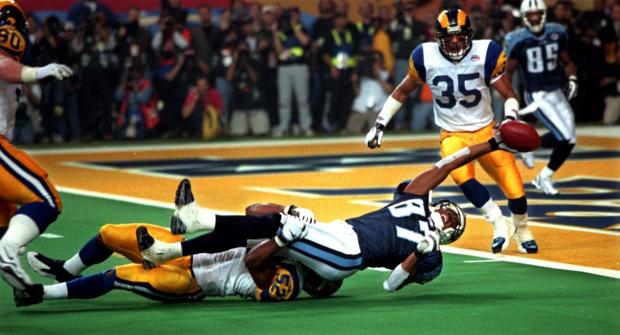
A picture of the game-saving tackle on the last play of Super
Bowl 34. Photo Credit
Sixteen years ago I skipped church to watch St. Louis in the Super Bowl. As football fans know, it was one of the best Super Bowl games ever. It was a thrilling victory, and given how extremely unlikely it will be for St. Louis to ever be in the Super Bowl again, it is a memory I will cherish forever. Makes me wish I had skipped church two years later. Maybe St. Louis would have won again. I’m joking, of course, but I am serious about not regretting not going to church. This principle applies in many areas where others might condemn us for a personal choice. Paul tells us, “Happy is he who does not condemn himself in what he approves.” In other words, if you have a clear conscience before God about your decision, don’t let others' judgmental attitudes keep you away from doing what you want to do.

Friday, January 29, 2016

TOMS: Jude

For an introduction to this series, click here.

January 28, 2008

Jude was a younger half-brother of the Lord Jesus. He introduces himself in his short epistle as the brother of James, but the Gospels mention several of Jesus' brothers, and one of them is Judas or Jude. Obviously this is not the same Judas who betrayed Jesus. Judas (or Judah) was quite a common name in 1st century Israel, particularly since most of the Jews living there were from the tribe of Judah.

Jude's book is quite short, but it is a very powerful condemnation of false teachers. This epistle was written late in the first century, certainly at a much later time than his brother James' epistle. Jude does not mention much specific doctrinal error like John does, but he does attack the motives of the false teachers. If you are around someone for very long, you know what motivates them, whether it is money or power or something more positive.

"Beloved, although I was very eager to write to you about our common salvation, I found it necessary to write appealing to you to contend for the faith that was once for all delivered to the saints. For certain people have crept in unnoticed who long ago were designated for this condemnation, ungodly people, who pervert the grace of our God into sensuality and deny our only Master and Lord, Jesus Christ. Now I want to remind you, although you once fully knew it, that Jesus, who saved a people out of the land of Egypt, afterward destroyed those who did not believe. And the angels who did not stay within their own position of authority, but left their proper dwelling, he has kept in eternal chains under gloomy darkness until the judgment of the great day— just as Sodom and Gomorrah and the surrounding cities, which likewise indulged in sexual immorality and pursued unnatural desire, serve as an example by undergoing a punishment of eternal fire." (vs. 3-7)

Jude jumps right in to this book with a warning about tolerating false teachers. Jude reminds his readers about the fact that people practicing wickedness throughout history have been judged by God and that they need to separate themselves from that wickedness, if for no other reason than to get out of the way of the coming judgment. God judged the angels who fell, He judged the people of Sodom for their wickedness and He judged the people of Israel who rejected Him, even after He saved them from Egypt.

"Yet in like manner these people also, relying on their dreams, defile the flesh, reject authority, and blaspheme the glorious ones. But when the archangel Michael, contending with the devil, was disputing about the body of Moses, he did not presume to pronounce a blasphemous judgment, but said, 'The Lord rebuke you.' But these people blaspheme all that they do not understand, and they are destroyed by all that they, like unreasoning animals, understand instinctively. Woe to them! For they walked in the way of Cain and abandoned themselves for the sake of gain to Balaam's error and perished in Korah's rebellion. These are hidden reefs at your love feasts, as they feast with you without fear, shepherds feeding themselves; waterless clouds, swept along by winds; fruitless trees in late autumn, twice dead, uprooted; wild waves of the sea, casting up the foam of their own shame; wandering stars, for whom the gloom of utter darkness has been reserved forever." (vs. 8-13)

These are dangerous people Jude's readers are dealing with. Don't get the wrong idea by the term "love feasts." This is just a reference to a meal shared by all the people in a church. Jude says that these people are a reef. A reef is, among other things, a hidden danger to ships as they sail through what looks like safe waters. These people were right in the midst of the church, and they were wicked men, unsaved and creating problems. Apparently some of them were leaders in the church, since Jude says they were like shepherds feeding themselves instead of feeding the flock. We need to be very careful of the people we put in leadership positions in the church. The Lord takes His church very seriously, and we should be very careful to make sure that those in authority take the church seriously as well.

Apparently, among their many other errors, they were preoccupied with demons. They were obsessed with casting them out and blaming all of people's problems on demons. I have met a couple of people like that. I knew one man, who later abandoned his wife and left the ministry, whose whole ministry seemed to change after he became preoccupied with the idea of demons. When I was very young, he came and preached several times at my church and was very good. He had a profitable ministry. But then things took a bizarre turn and his sermons started being all about demons and he had stories about all the demons he cast out of people and that sort of thing. Of course demons are real, but honestly it is not our job to try to confront them directly. Jude says here that not even Michael, the most powerful of the angels, came against Satan in his own power, but came in the power of the Lord Himself. As a general rule, don't trust someone who is preoccupied with demons as the source of evil in the world.

The story about Michael and Satan is actually an old Jewish legend that Jude records as fact in Scripture. In the next passage Jude quotes from another apocryphal source, the prophecy of Enoch. These days, people are obsessed with the apocryphal writings, particularly of the New Testament period. The "Da Vinci Code" book and movie, along with hundreds of other books touting "new evidence" about the origins of Christianity, is based on these writings. The church thoroughly studied and proved these writings to be false more than 1,800 years ago, but today these "brilliant" writers have dredged them back up pretending they have found something new. The moral of Jude's use of such material here is that they often can have accurate historical information in them, but if what they say goes against the plain teaching of Scripture, it is imperative that we leave that stuff alone and stick with the Bible. I have actually read some of the Apocrypha, the books that are included in the Catholic Bible. Most of what I have read is interesting historical information, but neither the Jews nor most orthodox Christians recognize it as scripture. Not even the Catholic church places it on the same level as the traditional Old and New Testaments.

"It was also about these that Enoch, the seventh from Adam, prophesied, saying, 'Behold, the Lord comes with ten thousands of his holy ones, to execute judgment on all and to convict all the ungodly of all their deeds of ungodliness that they have committed in such an ungodly way, and of all the harsh things that ungodly sinners have spoken against him.' These are grumblers, malcontents, following their own sinful desires; they are loud-mouthed boasters, showing favoritism to gain advantage." (vs. 14-16)

Jude continues here with his theme of judgment on wicked men, and what these believers need to do to get out of the way of the coming judgment. He quotes Enoch, who prophesied thousands of years ago that the Lord was coming to bring about judgment.

"But you must remember, beloved, the predictions of the apostles of our Lord Jesus Christ. They said to you, 'In the last time there will be scoffers, following their own ungodly passions.' It is these who cause divisions, worldly people, devoid of the Spirit." (vs. 17-19)

This passage is certainly a clue that this epistle was written late in the Apostolic Age. Jude mentions that the Apostles had already written about the fact that there will be mockers in the last days. This quote sounds an awful lot like II Peter 3, but Paul also wrote something similar in II Timothy 3, and there are other passages as well that warn about apostasy in the last days. Certainly things have only gotten progressively worse as the centuries have passed. 

"But you, beloved, building yourselves up in your most holy faith and praying in the Holy Spirit, keep yourselves in the love of God, waiting for the mercy of our Lord Jesus Christ that leads to eternal life. And have mercy on those who doubt; save others by snatching them out of the fire; to others show mercy with fear, hating even the garment stained by the flesh. Now to him who is able to keep you from stumbling and to present you blameless before the presence of his glory with great joy, to the only God, our Savior, through Jesus Christ our Lord, be glory, majesty, dominion, and authority, before all time and now and forever. Amen." (vs. 20-25, ESV)

This is Jude's conclusion. He reminds his readers to remain faithful to the Lord through whatever comes and to be faithful witnesses. They were to be witnesses both to those outside the church and those inside the church who were led astray by the false teachers. Lots of people like to quote verse 22 in the King James: "And of some have compassion, making a difference." The preacher in church yesterday said, "The Bible says, 'Compassion makes a difference.'" Well of course compassion does make a difference, but looking at it in context, what it is saying here is that Jude's readers (and that would include us) need to have compassion on those who have been led astray by the false teachers. When he tells us to "make a difference," it means to make a difference between the false teachers, who should be shunned, and those led astray by the false teachers - “those who doubt” - who can still be led to true Biblical faith. 

Tuesday, January 26, 2016

TOMS: 3 John

For an introduction to this series, click here.

January 25, 2008

John addresses this short epistle to Gaius, a man about whom we know very little other than the fact that John wrote an epistle to him. Gaius was a common Roman name, and there are a few men by the name of Gaius mentioned elsewhere in the New Testament.

"The elder to the beloved Gaius, whom I love in truth. Beloved, I pray that all may go well with you and that you may be in good health, as it goes well with your soul. For I rejoiced greatly when the brothers came and testified to your truth, as indeed you are walking in the truth. I have no greater joy than to hear that my children are walking in the truth." (vs. 1-4)

Perhaps John wrote this about wishing Gaius' physical health would prosper as his soul because Gaius was a sickly individual or had a medical condition. Or it may have been a more general greeting. Either way, John is obviously pleased with Gaius and his ministry on the whole, although there are a couple of issues John wants to address. John calls Gaius one of his children in verse 4. Most likely this means that Gaius was a spiritual son of John. It is unlikely a Jew like John would give his son such an obviously Roman name.

"Beloved, it is a faithful thing you do in all your efforts for these brothers, strangers as they are, who testified to your love before the church. You will do well to send them on their journey in a manner worthy of God. For they have gone out for the sake of the name, accepting nothing from the Gentiles. Therefore we ought to support people like these, that we may be fellow workers for the truth." (vs. 5-8)

In 2 John, the Apostle addresses problems that arise when well-meaning Christians help false teachers. In 3 John, he addresses the problems that arise when Christians do not do enough to support genuine servants of the Lord. These traveling teachers probably were similar to what we would consider evangelists now. They traveled from church to church, teaching sound doctrine directly from the Apostles and further encouraging the churches. Gaius and his congregation were apparently not doing their part to further these men's ministries. What a shame it is that, even today, false teachers rake in donations by the millions while those who are really doing a good work for the Lord seem to struggle to get by. Now I know that there are a lot of issues involved, but the fact remains that those of us who know the Lord and are trying to live by the Word of God should be giving more to help brothers and sisters who are honorably doing the Lord's work. I know the Lord tells us to give as we see fit, but the fact still remains (at least for me) that I need to see fit to give more.

As a passing note, when John says these men accepted nothing from the Gentiles, John is most likely using that term to describe the lost world. The word Gentiles is used in that context several times in the epistles. Basically it means that the church was the only means of support for these teachers.

"I have written something to the church, but Diotrephes, who likes to put himself first, does not acknowledge our authority. So if I come, I will bring up what he is doing, talking wicked nonsense against us. And not content with that, he refuses to welcome the brothers, and also stops those who want to and puts them out of the church. Beloved, do not imitate evil but imitate good. Whoever does good is from God; whoever does evil has not seen God. Demetrius has received a good testimony from everyone, and from the truth itself. We also add our testimony, and you know that our testimony is true." (vs. 9-12, ESV)

People like Diotrephes are a detriment to the church. Doubtless Diotrephes was well-respected in the community and the church. Many may have called him a natural leader. But unfortunately he was using his God-given abilities (and probably wealth and other influences) to stir up trouble in the church. He was very critical of these teachers that John mentions earlier as honorable servants of God. He personally did not like them, and tried to run off or even discipline those who did. Diotrephes was probably a big reason Gaius' church was not doing enough to meet the needs of the evangelists. 

Church leaders need to be very careful whom they put in leadership. Someone like Diotrephes can wreak so much havoc in the church it is scary. Not only in the church, but his stubbornness and hatefulness even reached outside the church, affecting these evangelists and causing the Apostle John enough grief that he felt compelled to write this letter. The church has to be bigger than any one man.

Later John mentions an example of a man who deserved more esteem in the church, namely Demetrius. Perhaps Gaius needed his eyes opened to see the problems that were right in front of his face. It seems that he and the church as a whole were relying too much on Diotrephes for leadership, a critical, narrow-minded man, and were overlooking the gifts of Demetrius, a humble, generous man who was doing the Lord's work without drawing much attention to himself. Lord give us more Demetriuses and fewer Diotrepheses in our day!

Monday, January 25, 2016

TOMS: 2 John

For an introduction to this series, click here.

January 24, 2008

This little letter (the shortest book in the Bible) was written by John to the "elect lady," whoever that may have been. If you have read the rest of John's writings, the themes here are quite similar.

"The elder to the elect lady and her children, whom I love in truth, and not only I, but also all who know the truth, because of the truth that abides in us and will be with us forever: Grace, mercy, and peace will be with us, from God the Father and from Jesus Christ the Father's Son, in truth and love." (vs. 1-3)

Whoever this lady was, she was probably well-known at the time among the first-century church. Other than that, this is a pretty standard opening for an epistle.

"I rejoiced greatly to find some of your children walking in the truth, just as we were commanded by the Father. And now I ask you, dear lady— not as though I were writing you a new commandment, but the one we have had from the beginning— that we love one another. And this is love, that we walk according to his commandments; this is the commandment, just as you have heard from the beginning, so that you should walk in it. For many deceivers have gone out into the world, those who do not confess the coming of Jesus Christ in the flesh. Such a one is the deceiver and the antichrist. Watch yourselves, so that you may not lose what we have worked for, but may win a full reward." (vs. 4-8)

Once again we find John reminding his readers to love one another. Love is a vital element for the Christian life. You notice that John also points out that true Christian love involves more than a feeling: it requires walking in God's commandments.

We also find John warning against the error of gnosticism. The gnostics denied the humanity of Christ and taught that He was merely a spirit being. John made a point of pointing out that it is false doctrine to deny that Jesus came in the flesh.

John includes another serious warning as well: we can lose rewards in heaven if we are unfaithful to the Lord. As Christians we have the privilege of earning rewards in heaven. But those rewards are conditional upon our faithfulness. 

"Everyone who goes on ahead and does not abide in the teaching of Christ, does not have God. Whoever abides in the teaching has both the Father and the Son. If anyone comes to you and does not bring this teaching, do not receive him into your house or give him any greeting, for whoever greets him takes part in his wicked works." (vs. 9-11, ESV)

God takes doctrinal purity seriously. There are minor things that no Christians will ever agree completely on. To divide over these things is foolish and unnecessary. But there are a number of things in Scripture that are non-negotiable. John goes so far as to say that we should have nothing to do with these false teachers, not even a greeting. That is serious. In our society, we are told to be tolerant of everyone, even those with whom we disagree (those who use the word "tolerance" the most are often some of the least tolerant people out there, but that is another topic for another time). Instead of trying to win them back, we need to just have nothing to do with them until they show signs of repentance. Now of course this goes for teachers, leaders in the Christian community. I don't think John is telling us not to have anything to do with relatives, friends or neighbors who hold unorthodox doctrine; I think he is talking about teachers and about how the church should deal with them.