One man's view of theology, sports, politics, and whatever else in life that happens to interest me. A little bit about me.

Monday, December 8, 2014

TOMS: Matthew 4

For an introduction to this series, click here.

Dec. 7, 2006

Chapter 4 gives us the story of Jesus' temptations and the calling of the first disciples. A lot has been written over the years about these temptations, yet there is still so much that we (or at least I) don't really understand about it. Why was it necessary for Jesus to go out into the desert for 40 days without food? Couldn't Satan just as easily tempted Him while He was going about his daily life? I know it was all part of God's plan. Why would it have been sin for Jesus to change the stones into bread? It can't be simply because Satan told Him to do so. I guess the best answer would be that the fasting was part of God's plan, and the miracle would have been cheating. The other two are simpler for me to understand. Satan wanted Jesus to put on a big show, draw undue attention to Himself, and be tempted with pride. The final temptation was a shortcut to what Jesus and Satan already knew was Jesus' destiny.


Jesus' ministry actually began after the temptation. Jesus was immediately popular. He was a sensation. People came from all over to be healed, verse 24 says even as far as Syria.


A lot of people in our time misunderstand Jesus' disciples. In first century Israel, rabbis were not only the spiritual leaders of a community, they were also the educators. Most boys went to rabbinical school in their community to at least learn to read and write. Those who showed promise or whose parents could afford it lived with the rabbi beyond their elementary, if you will, education and continued their education. Jesus was not the only traveling rabbi in Israel, and He was certainly not the only one to have an entourage of learners following along.


This is the main reason I think the disciples were very young men when they traveled with Jesus, possibly teenagers. John, for example, wrote his five books as late as 65 years after the death of Christ. Obviously John was very old by any measure. But if he was 80 when he wrote the Revelation, that would make him around 15 when Jesus died. If John was the same age as Jesus, he would have been nearly 100 when he wrote the Revelation. We usually picture the disciples as men at least as old as Jesus, but that's mainly because that's the way they are pictured in art produced some 1,300-1,600 years later. For one thing, most people did not live very long lives anyway back at that time. As far as we know, Peter was the only disciple who was married, so he probably was somewhat older. Remember that in John 20 John outran Peter to Jesus' tomb.

It's nothing to quibble about, but it is something to think about.

Sunday, December 7, 2014

TOMS: Matthew 3

For an introduction to this series, click here.

Dec. 6, 2006

Chapter 3 tells us the story of John the Baptist, or as I like to call him, John the Dipper. Because that's really what he was. (I'm revealing my Baptist roots here). I'm not going to get bogged down in a Baptist defense of immersion. I'll leave that to the experts.


Anyway, John, Jesus' cousin, came preaching the word of God. He lived in the desert, for how long we don't know, but apparently he left his father and mother at an early age. His parents were quite old when he was born, so perhaps they died. Certainly he learned to rely on God for his needs out in the desert. Often in Biblical history God took His servants to the wilderness before He brought them back for service. Look at Moses, David, Elijah, Paul, etc. Anyway, he comes back to civilization and creates a commotion. It had been 300 years since a prophet had been seen in Israel. Then John breaks onto the scene, and everyone goes out to hear him. He preaches a hard message:
"Bear fruit in keeping with repentance. And do not presume to say to yourselves, 'We have Abraham as our father,' for I tell you, God is able from these stones to raise up children for Abraham. Even now the axe is laid to the root of the trees. Every tree therefore that does not bear good fruit is cut down and cast into the fire. I baptize you with water for repentance, but he who is coming after me is mightier than I, whose sandals I am not worthy to carry. He will baptize you with the Holy Spirit and with fire. His winnowing fork is in his hand, and he will clear his threshing floor and gather his wheat into the barn, but the chaff he will burn with unquenchable fire." (3:8-12, ESV)


John preached a message of repentance and good works that follow salvation. This is a message sorely needed in our time. Not that we can do anything to merit salvation, but that salvation produces a change in our life. That is the main point of John's message.


One of the outward fruits of repentance was a willingness to be baptized. Now here is where most teachers (at least the ones I have heard) miss the significance. 1st century Judaism was a religion on the march. They were not content to practice their religion on Saturday. They were actively proselytizing (I think that's spelled right) Gentiles, especially in the areas where the Jews had been scattered. There were Jews all over the Roman Empire (remember the Jews at Pentecost in Acts 2 who came from all parts of the world) and they were militant for the faith. Baptism was a public symbol of a Gentile's conversion to Judaism. Here came John baptizing Jews, and the Jewish leaders were upset. "What were these people converting to?", the leaders wanted to know. Baptism was never intended as a means of grace or a washing away of original sin. It was a sign that an adult had changed their religion. That's why baptism was essential in the early church. They were living in the midst of a Jewish culture that would have understood the sign. That's why the Ethiopian ruler in Acts 8 wanted to be baptized. He understood that it was a symbol of a new life.

I didn't want to go this long, so I think I will address why Jesus was baptized when it comes up again.

Saturday, December 6, 2014

What if?

Is every Christian who enjoys football an idolater?
Some folks make it seem that way. Photo Credit
You've seen it in your Facebook feed, heard it in sermons, maybe even said it yourself: something to the effect of "What would it look like if we got just as excited about Jesus as we got about" fill in the blank - football, NASCAR, Christmas shopping, deer hunting, American Idol - the list is endless. I've come to the conclusion that's not the right question for us to be asking other people. It reveals a faulty understanding of Scripture and lays an unnecessary burden of guilt on those who may take it seriously.

Why do I say that such a statement reveals a faulty understanding of Scripture? Let’s look at a few verses. Romans 14 (and the first part of chapter 15), as you may know, is an important passage giving us direction on charitably handling differences of opinions and preferences. Most of the passage is about the stronger brother (the one who trusts that all things not obviously sinful are gifts from God) not offending the weaker brother (the one who has objections that such life choices are sinful). But in order for the weak and strong brothers’ relationship to work, consideration has to go both ways:
"Let not him who eats despise him who does not eat, and let not him who does not eat judge him who eats; for God has received him. Who are you to judge another’s servant? To his own master he stands or falls. Indeed, he will be made to stand, for God is able to make him stand.” (Romans 14:3-4)
“Do not destroy the work of God for the sake of food. All things indeed are pure, but it is evil for the man who eats with offense. It is good neither to eat meat nor drink wine nor do anything by which your brother stumbles or is offended or is made weak. Do you have faith? Have it to yourself before God. Happy is he who does not condemn himself in what he approves. But he who doubts is condemned if he eats, because he does not eat from faith; for whatever is not from faith is sin. (Romans 14:20-23)

“Happy is he who does not condemn himself in what he approves.” When we (I’m including myself, because I’ve done it too) condemn other people for participating in stuff we may not particularly care for, we are violating that principle in the lives of others. In the first passage quoted above, it is not our place to judge a fellow believer in such matters. God is the judge for all of us, and He will work in a believer’s life if they have a genuine problem.

Another portion of Scripture that has a direct bearing on this topic is Deuteronomy 14:22-29. This passage is about the special, every-three-years tithe that the Hebrews were to bring to the house of the Lord. Notice what verse 26 says specifically:“And you shall spend that money for whatever your heart desires: for oxen or sheep, for wine or similar drink, for whatever your heart desires; you shall eat there before the Lord your God, and you shall rejoice, you and your household.” (NKJV)

This tithe was not merely a donation, although that was part of it. Part of this special tithe was that a person would buy whatever food or anything else they wanted with the tithe money, and enjoy it in the presence of God. This time of enjoyment was just as much an offering to God as sacrificing a lamb or a calf, and equally a part of God’s commands for His people at that time. Now I know we can’t directly appropriate Old Testament laws for the church age, but the principle is pretty clear: God is honored by us enjoying anything that makes us happy when we acknowledge Him while we are doing it. If you struggle with this, I recommend you read the entire passage.

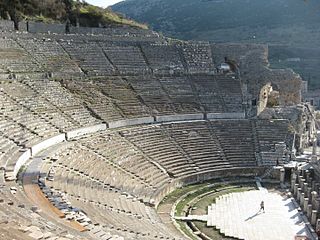
This is the amphitheater in Ephesus,
where Paul spent three years. Could
he have seen a play here? Photo Credit
Nowhere in the Bible will you find that it is wrong to enjoy food, activities or hobbies in this life. In fact, Paul on at least four occasions - Acts 17:28 (two references in that verse), I Corinthians 15:33 and Titus 1:12 - referenced pagan Greek poets or playwrights in his discourses and epistles. It’s hard for us to think of Paul taking a break from his work building churches to go down to the city amphitheater to see a play, but apparently it’s something Paul enjoyed.

As many people as there are in the world, there are that many and more things that make them happy. This is not a bad thing. God intended for us to enjoy His creation, enjoy spending time with each other, enjoy making and doing things that make us happy. Whenever I hear someone make some remark (particularly when it’s obviously addressed to me) about somebody loving some activity more than they love Jesus, the thing I infer from that question is that someone thinks I have an idolatry problem. They think I love something more than I love Jesus. That seems to me a reasonable inference to make. How can they know? What business is it of theirs?


Do we need to guard our hearts? Certainly. Even though we are Christians, the unregenerate part of our being is capable of creating an idol out of practically anything, including the fact that we don’t do such-and-such, so we must love Jesus more. We have an entire lifetime of work on our own to keep our own hearts and minds where they need to be before God.

Is it wrong to encourage one another to love Jesus more? Of course not. In fact we are repeatedly commanded in the epistles to do exactly that. But is laying a guilt trip on someone for enjoying something not sinful a good way to encourage each other? No. My advice to you (and for me) is to find positive ways to genuinely encourage one another. Find a good quote or picture or article, and share that on Facebook instead of condemnatory rhetoric. Share your spiritual journey with the folks at your church. I find that the most encouraging things people talk about at church is how we are really working through some issue or circumstance in our lives. That’s encouragement that will make a difference in people’s lives. Condemnatory, arrogant attempts at encouragement only break people down. That’s not what the church or the broader community of believers is for.

Friday, December 5, 2014

TOMS: Matthew 2

For an introduction to this series, click here.

Dec. 5, 2006

Chapter 2 tells us the story of the "wise men." Now you can say what you want about them, but the fact remains that they were Eastern mystics, people the Jews would likely classify as wizards or sorcerers. In fact, the same Greek word, magos (the plural is magi), is used to describe the greedy Simon the Sorcerer in Acts 8 and two other magicians, Bar-Jesus and Elymas, who confronted Paul and Barnabas in Acts 13. You don't have to be an etymological expert to understand that magos is the Greek root for our English word magic.


Let's also discuss the idea of the number of wise men there were. Just because there were three gifts does not mean there were three men. If three weird foreigners came into town looking for a king, nobody would have given them a second thought. They would have been viewed as old crackpots. But Matthew clearly states that all Jerusalem was in an uproar over the arrival of these wizards (let's call them what they were.) Then just consider the practicality of traveling across the desert like they must have. They would have needed an entire caravan just to travel that far. Not only do you need supplies, but the desert was full of highwaymen. People traveled in large caravans in part for protection from robbers. So there were certainly more than three men. There were probably dozens, if not hundreds of them. They may not have all had the same rank, but they would have been in the traveling party.


They all believed they saw something special, and they were willing to travel a thousand miles or better. Were they believers in Jehovah God? You bet. Even if they didn't believe when they set out, they gave their word to the king that they would come back to him. These men would not have taken such a promise to the king of a foreign country lightly. But they went the other way when the angel told them to, which is a fine example of faith acting on the command of God. I'm looking forward to seeing them in heaven.


This all makes the Christmas story even better when you think about it. When the greatest Man in human history was born, God did not call a press conference. He didn't even bother to tell the Jewish leaders in Jerusalem. He told a group of freakish wizards a thousand miles away, and He told a group of illiterate shepherds right outside of town. God does not do things the way we would do them. He chooses to reveal Himself to whoever He wants to, often to the strange and unpleasant among us. Practically everything God ever did in the Bible would fly in the face of what human reasoning would recommend. In His life, the Lord Jesus did many strange things, which hopefully we will discuss in the coming weeks.

I hope you don't find all this blasphemous. I certainly don't want to be flippant or irreverent in handling the Word of God. I haven't quoted a lot of Scripture in the past couple of posts, primarily because I think most of the people reading this are terribly familiar with the story. I always like to try to find a different perspective every time I look at anything, whether it's a person, book, movie or whatever else. I don't like to get caught in a rut, and if maybe I can help you look at things differently, then this time won't be wasted. God bless you all.

Thursday, December 4, 2014

TOMS: Matthew 1

For an introduction to this series, click here.

Dec. 4, 2006

Well, I had some trouble posting Thursday night. I don't know what happened. Anyway, I was back home for the weekend, so no internet. Starting with this post, I'm going to go chapter by chapter through the New Testament. And the most logical place to start would be Matthew 1.


Matthew starts with a genealogy (that's a weird word to spell) that begins with Abraham and ends with Jesus. As we will discuss in a number of places in this book, Matthew was written primarily to a Jewish audience. In a sense all the Synoptic Gospels (Matthew, Mark and Luke) were written for specific audiences, but Matthew is more Jewish than Mark is Roman or Luke is Greek. Genealogy was (and still is) very important to Jews. Their family was their identity, much more so than to Americans today. How ironic it is that a man who was probably rejected by most of his (Jewish) family and friends would write a gospel directed to the Jewish people. Before he met Jesus, Matthew was a publican, a tax collector who, in the mind of many of his countrymen, was collaborating with the enemy: Rome.


After the genealogy, Matthew recounts the birth of Jesus, mostly from the perspective of Joseph. As a Jewish man, Matthew would have probably identified with Joseph's predicament. Here he was about to marry this girl, and all of a sudden she comes up pregnant. No doubt heartbroken, Joseph is prepared to just drop the whole thing. By Moses' law, he could have dragged her out to be stoned, but Joseph was a "just man." It's hard to imagine what was going through his mind when the angel came to him, but it is clear that he believed the angel and even took Mary home before she gave birth. They did not have sex before she gave birth, but apparently she did start to live with him. Maybe her parents didn't understand and threw her out of the house. We do know from Luke's gospel that Mary went to live with her cousin for a few months. It is possible that she moved straight from Elizabeth and Zechariah's house to Joseph's.

We get the story of the wise men in Chapter 2. We'll see you tomorrow night.