One man's view of theology, sports, politics, and whatever else in life that happens to interest me. A little bit about me.

Thursday, February 16, 2017

Jesus vs. Paul?

Misunderstood Verses #2

Matthew 6:14-15: For if you forgive men their trespasses, your heavenly Father will also forgive you. But if you do not forgive men their trespasses, neither will your Father forgive your trespasses. ~ Jesus

Ephesians 4:32: And be kind to one another, tenderhearted, forgiving one another, even as God in Christ forgave you. ~ Paul

Recently I've become aware of a teaching that proposes that Jesus and Paul are at odds in these two statements. They say that Jesus says our forgiveness (which has to mean our salvation, since no one I'm aware of teaches one can be partially forgiven and go to heaven) is based on our forgiveness of others - that is our performance. Paul tells us that we forgive others because of how completely God has forgiven us.

The resolution they provide seems simple enough: Jesus was talking about a different era in God's redemptive history. Before the cross, before the resurrection, before Pentecost, whenever, God dealt with people on the basis of their performance. But now God deals with us based on Christ's all-sufficient work on the cross. It sounds plausible, because Hebrews tells us about the new and living way we have in Christ. But some (not all) who teach this are overzealous for the new and living way. In their exuberance they overlook a God who has always shown mankind mercy and grace.

If Jesus was saying that there was a time (obviously it had to include the time that Jesus was speaking) that God's forgiveness was conditional on our action, then that must mean no one from that era will be in heaven. I don't think I need to post any references to the fact that man can in no way earn God's favor, since if you've read this far you are interested enough in Scripture to understand that. God's grace has never been in this time or any other time based on man's performance.

To de-emphasize God's grace in previous times is to do injustice to our unchanging God and the great heroes of the Old Testament. Genesis 15:6 tells us, "He (Abraham) believed in the Lord, and He accounted it to him for righteousness." Three times in the New Testament (here, here and here) this verse is quoted as an illustration of the way we all must come to God. I'm thankful for the more complete revelation we have in Christ, but all God ever required, requires now and will ever require is belief in him.

So if Jesus was not saying that forgiveness is based on our performance, what did he mean? And how are Jesus' and Paul's statements rectified? To me it seems simple, because the key is in another verse in Ephesians: "For we are His workmanship, created in Christ Jesus for good works, which God prepared beforehand that we should walk in them." (2:10) If we as believers are ordained by God to walk in good works, is it not reasonable to assume that forgiveness will be one of those good works? And if so, then truly one who can never find it in their heart to forgive their fellow human knows nothing of the love, mercy and forgiveness of God.

We as believers will fail to forgive one another completely. If we wouldn't, why would Paul need to encourage us to forgive in the second verse above? We certainly deal with the works of the flesh in our hearts and lives. But we are just as certainly on the road to being the people God wants us to be. God promises to work in our lives to bring us farther on that road, but the journey won't be complete till we get to heaven.

Thursday, November 10, 2016

How Hillary Could Have Won

It's been a couple of days since Election Day 2016. Personally I am not disappointed Hillary lost, but I think she lost for one particular reason: she failed to make the campaign about issues. Had Hillary focused her speeches, her debates and advertising war chest on the contrasts (or, more importantly, the lack thereof) between herself and Trump, she would have driven a wedge between Donald Trump and his conservative base and won easily. Instead she relentlessly attacked Trump's personality, which only fueled his base to get out and vote.

If you had your TV on at any time in the last three months, chances are you saw it: the ad with the children sitting in front of the TV watching as Donald Trump made one extreme remark after another. It probably won't go down in history alongside other memorable TV ads from past campaigns (mostly because Hillary lost and most people remember winners' ads), but it is definitely the most memorable of this campaign. This ad, for better and for worse, exemplifies Clinton's entire campaign strategy: pointing out what a nasty scoundrel Donald Trump is.

Hillary's campaign staff and her supporters in the press and popular media followed this strategy to the letter. Late night comedians constantly pointed out Trump's flubs and erratic behavior every night of the week. Democratic panelists on various news shows focused on the seedy characters Trump seemed to attract, from Milo Yiannopoulos to David Duke. Some went on to imply (and in some cases declare outright) that all or most of Trump's support came from extremists like them.

This was the wrong strategy to take because it only served to fuel Trump's base's rage against the political, media and entertainment elite. They knew Trump was and is a sorry human being. A large portion of his base (at least many from all over the country that I talked to personally and on social media) was reluctant in their support. Hillary failed to turn that reluctance into a decision to stay home.

Most conservatives (I say this as a conservative-leaning libertarian who grew up around conservatives and who lives in a very red state - Alabama) have a persecution complex. They are used to being marginalized, ignored and villainized by the movers and shakers of society, and they tend to identify with people who are the targets of attacks from the left. If you want an example, look no further than Sarah Palin. The more liberals made fun of her, the more conservatives loved her, bought her books and tuned in to her TV shows.

Trump understood this. He was willing to take the abuse and dish out some of his own, which only further stirred his base, many of whom felt that both Romney and McCain failed to attack Barack Obama. Romney in particular further alienated the Republican base by failing to take a strong stand on issues dear to conservatives.

Had Hillary commended Trump for his stance on LGBT issues,
how many conservative votes would Trump have lost?
Photo Credit: Colorado Log Cabin Republicans
Here's where 2016 was different from 2012: in the debates and with his stump speeches President Obama made Romney speak to these divisive issues. And when he did, millions of conservatives stayed home. Clinton by and large did not attack Trump on any specific issues. And she had wide-open opportunities to do so. Trump is not a dyed-in-the-wool conservative. Many of his positions, especially on social issues, are similar to Clinton's. In particular, look at Trump's embrace of LGBT rights. Many conservatives, particularly conservative Christians, would balk at such positions. They are the type who would stay home rather than vote for the "lesser of two evils." Clinton did not need to attack Trump in this regard. She could have praised him for having an openly gay man speak right before his acceptance speech at the GOP Convention. She could have made a big deal out of finding common ground with Trump.

But Clinton never brought this up. Maybe she was afraid if she found common ground with Trump that some of her support might go away. Maybe she was afraid of humanizing someone she was determined to treat with disdain. Whatever the reason, the ceaseless personal attacks continued, and with each one she dug herself into a deeper hole she ultimately could not climb out of.

Tuesday, November 1, 2016

Double (switch) or Nothing: How Baseball can Improve Mid-inning Pitching Changes

Pitching changes like this one that disrupt the flow of the game are one of the sources of frustration for fans who wish MLB games wouldn't last so late into the night. Credit: Benny Sieu-USA TODAY Sports

Most fans agree Major League Baseball needs to speed up its games, postseason and regular season. Part of the solution might be to require a double switch to change pitchers in the middle of an inning. Even if it doesn't shorten the game, it will make it more interesting.

This week will mark the conclusion of this year's World Series. It has been the most exciting, the most talked-about and the most watched Series in recent memory. But once again baseball fans are complaining about a topic that seems to come up every postseason: the games are too long, and go too late at night. Lots of people have said the late games are why baseball's national ratings have trended down over the last few years. The facts seem to say otherwise though. Ratings tend to go up the later the games go, according to the networks and the ratings services.

Nevertheless, I agree that the games go too long. The longer commercial breaks are a part of it, and that honestly can't be helped. You can't expect FOX (or any other network in their position) not to take advantage of a large national audience, especially given the large fees they pay the league to broadcast the games.

But another factor is constant pitching changes. It's not uncommon to see five or six pitchers pitch the last four innings of a game. The other night the FOX announcers quoted Cleveland manager Terry Francona as saying that posteason baseball is different: there is more pressure to do everything exactly right and that leads to more pitching changes based on matchups with batters. You do see this to some extent during the regular season as well, but it certainly seems worse in October. When teams carry four, sometimes only three, starters in the postseason and as many as eight or nine relievers on the roster, it becomes a self-fulfilling prophecy: more relievers are available, therefore more get used.

Here is how my double-switch solution works: the starter can be taken out at any time with no penalty. If he runs out of gas with two outs in the sixth, is getting blown out in the third, or whatever the situation, the manager should be able to replace him at any time. However after the first reliever comes in, he can only be removed at the end (or beginning, depending on how you want to look at it) of an inning without a penalty. If the reliever comes off the mound with less than three outs, someone else has to come off the field as well. In American League play, a manager would have a choice of replacing the designated hitter instead of taking out a fielder. Either way though, someone else has to come out of the lineup. There would be a few obvious exceptions: injury to the pitcher, weather delays, etc. The umpires would have discretion in these scenarios.

What about extra innings? To that I ask how many times do you see mid-inning pitching changes in extra innings? They are rare, and even more rare the deeper the game goes into extras. So this will kind of take care of itself. There is no need to waive the rule for situations in which such pitching changes are not usually made.

Will this change bring back games of less than two hours? No, of course not. But it could make managers think twice about bringing in a pitcher to face one batter, resulting in two additional commercial breaks in one half-inning. It will bring a new layer of strategy to the game. If a team doesn't have any players on the bench, then the pitcher has to stay out there. It might make a team decide to add a sixth utility player instead of a ninth reliever to the roster.

Most importantly, it would be a fun change and give people something to talk about in the stands and at home. Instead of, "Oh no, a pitching change," it would be, "Ooh, who's coming out of the field? Or will he switch DH's?" Baseball fans love the intrigue, the way the lineup works. This would give them a reason to stay tuned during a pitching change instead of switching channels or going to the bathroom or shutting off the TV and going to bed. And fan engagement is why we love the games we love, isn't it?

Saturday, October 29, 2016

The New F-Word?

This will be the first in a series of articles about verses that I think have been misapplied down through the years.

Misunderstood Verses #1

Matthew 5:22: And whoever says to his brother, ‘Raca!’ shall be in danger of the council. But whoever says, ‘You fool!’ shall be in danger of hell fire.

For most of my life, I've heard this verse explained to mean that Jesus does not want us to use the word "fool" to describe someone. I suppose that's not the best thing to say to a person, but I believe Jesus had a much deeper and more profound message than just that. If you think Jesus was adding another four-letter word to the list that nice people don't say, then you are missing the point.

I'm told the Aramaic (the dialect of Hebrew spoken in Palestine during Jesus' time) word "raca" means "empty-headed." Seems to me that's not much different than "fool." But you could be brought to the council for saying one and not the other. Why bring someone who uses one insult before the council and not another? The logical assumption is that "raca" was a profanity in Jesus' day.

Photo Credit
Every society has profanities - words, gestures, etc. They vary from culture to culture. My dad served a tour of duty in Vietnam with the Marines. He never did and still doesn't talk about very much of what he experienced there, but one thing I remember him talking about was the fact that an innocent-looking (to Americans) "come here" gesture was a vile profanity in Vietnam. One of the things they trained foreign soldiers before they arrived in Vietnam was to not use that particular gesture.

Profanities are a part of the human experience. Whether that's a good or bad thing, I'm not quite sure, but the fact remains every society has them. In Jesus' day, one of the worst things you could say was "raca." It was apparently so bad that even saying it in public would get you sent before the religious authorities. The religious authorities in Jesus' day had limited but real power. They couldn't criminally punish, but they could embarrass people in front of the community in a way that kept most people in line with Jewish customs.

What kind of words are so bad that Jesus would say they are worse than cuss words? Very simple: words that hurt and leave a lasting impression on their victims. It might not be pleasant, but think back: every one of us can remember something someone said that cut us to the core like a knife. Maybe it was a classmate or group of classmates at school. Maybe a coworker or a boss. Sadly for some folks it might be something a teacher or even their parents said. I could be wrong, but I'd be willing to guess the person who said memorably hurtful things to you didn't use a string of four-letter words. Even if they did, it wasn't the cuss words that hurt you nearly as much as what they were saying beyond those words.

This, I believe, is the point Jesus was making here. The religious authorities of Jesus' day (and lots of people today) thought saying swear words was the worst sin you could commit with your mouth. As long as they didn't say those words, they thought they were doing pretty good. But Jesus said real sin goes a lot deeper than that. Words spoken in anger, pride and condescension can do lasting damage to people, regardless of whether there are cuss words thrown in or not.

I'm not saying you ought to go around cussing a blue streak. Jesus didn't say the council was wrong for punishing people who swore. What Jesus was warning against was the attitude that says as long as I'm not saying the words on somebody's naughty list then whatever I want to say is fine. It's not fine. Paul said that our words should "impart grace" to those who hear them. That should be the ideal that you and I should strive for: to be the kind of people whose words bring encouragement and grace to others.

Friday, February 5, 2016

Super Self-Congratulation Sunday?

Photo Credit
This Sunday is the Super Bowl. I don’t need to tell you that it will be one of the biggest events of the year. It’s a part of the fabric of the American culture.

Unlike most of my fellow Americans, I have only seen one Super Bowl live from beginning to end. In the majority of those instances, I have missed the Super Bowl because of Sunday evening church. I'm not writing to complain that I'm deprived or anything like that. I’m also not going to say it’s stupid to have church on a night when most of the people there would rather be home or at a party. I wouldn’t waste your time with such topics.

What I am writing about is the often-unstated assumptions that go with church on Super Sunday night. These assumptions center around the idea that we are somehow more pleasing to God because we are at church on a particular night of the year. In many churches I have been a part of or a visitor in, Super Bowl Sunday becomes “Prove How Much We Love Jesus” Sunday.

Here’s the first problem as I see it: Sunday night church in the fundamental/conservative evangelical circles I grew up in (and am still a part of) is hardly sacrosanct. We'll cancel church for anything: holidays like Memorial Day or July 4th, Christmas and Easter (the fact that many F/CE’s go to church less often during the seasons of Christmas and Easter is certainly full of irony, but that is another topic for another time), bad weather and more. But come blizzard or flood, we're going to have church on Super Bowl Sunday night. Why? Because that's the way it's always been done, and it feels good to be doing something so “spiritual.” 

And that leads me to a second, more insidious problem: the faulty belief that we are proving something to God or to the world by being at church. I know this is real because I have experienced it. Super Bowl Sunday night services are never normal. There is a charge in the air. 

In the worst cases, I have seen the whole service be about how wonderful it is that we are better than the church down the road that canceled services or, even worse, is showing the game and invited the community to a watch party. Other times the message may be about how shameful it is that some of the members are here but would rather be watching the game. I’ve seen the song leader make sure to sing all 5 verses of each song (to an audible chorus of groans), and the pastor making jokes about preaching an extra long sermon. I haven’t yet been to a service where the prayer went, “God, I thank you that I am not like other men,” but it’s not beyond the realm of possibility.

The fact is that God can’t love us any more. He sent His only Son to die and pay the penalty for our sins because He wanted to have a relationship with us. How much more love do you need? Our acts of piety don’t bring us any closer to God. We draw closer to God through obedience. Samuel told Saul, “To obey is better than sacrifice,” and Jesus quotes Hosea when He says, “I desire mercy and not sacrifice.” 

Does that obedience include church attendance? Yes it does. But if we are meeting to congratulate ourselves or to lay a guilt trip on people who are there but would rather be watching the game, we are not fulfilling the purpose of the church. 

Am I telling you not to go to church this Sunday evening? No, I’m not. Maybe you don’t like pro football, or maybe you don’t really care about either team in the game. There could be as many legitimate reasons to go to church as there are believers in whatever churches are having services. My plea to my fellow believers is not to be pharisaical about it. Don’t judge others who aren’t there. Don’t be proud of yourself because you are there. Don’t think going to church will give God opportunity to favor your team. And, if I may say so, if you really want to see the game, do it. And don’t lie to your pastor next week about the kids being sick or something. 


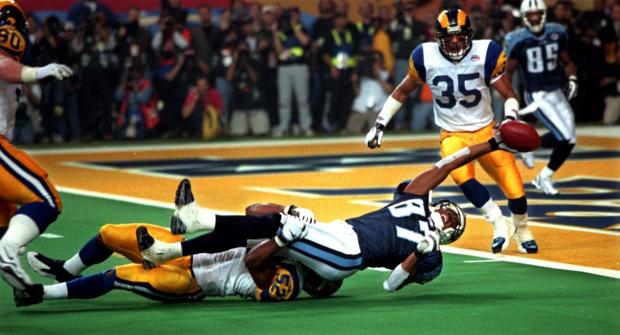
A picture of the game-saving tackle on the last play of Super
Bowl 34. Photo Credit
Sixteen years ago I skipped church to watch St. Louis in the Super Bowl. As football fans know, it was one of the best Super Bowl games ever. It was a thrilling victory, and given how extremely unlikely it will be for St. Louis to ever be in the Super Bowl again, it is a memory I will cherish forever. Makes me wish I had skipped church two years later. Maybe St. Louis would have won again. I’m joking, of course, but I am serious about not regretting not going to church. This principle applies in many areas where others might condemn us for a personal choice. Paul tells us, “Happy is he who does not condemn himself in what he approves.” In other words, if you have a clear conscience before God about your decision, don’t let others' judgmental attitudes keep you away from doing what you want to do.